
Contents

Virtual Surgical Planning
What Is Virtual Surgical Planning?
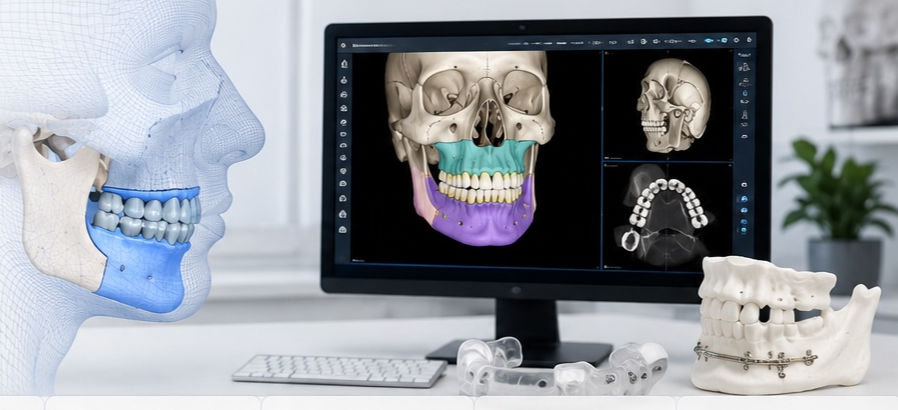
In VSP, a 3D model of the skull, jaws and teeth is created from your scans. The surgeon moves the jaws on the computer, checks the bite, symmetry, airway and facial profile, and finalises the plan before you enter the operating room.
Planning is led by the operating surgeon in coordination with your orthodontist, so diagnostic, surgical and aesthetic considerations are integrated in one plan.
From CT Scan to Surgical Plan: The Digital Workflow
1. Clinical examination, photographs and facial analysis
2. CBCT imaging and intraoral (digital dental) scans
3. Merging the scans into one accurate 3D model
4. Diagnosis and virtual movement of the jaws
5. Checking the bite, symmetry, airway and soft-tissue profile
6. Producing 3D-printed surgical splints that guide the jaws into the planned position during surgery
What VSP Can and Cannot Predict
VSP predicts bone and tooth positions accurately. Soft-tissue predictions, such as changes to the lips and nose, are estimates, because soft tissues respond differently in each person.
Swelling, healing and individual tissue characteristics also influence the final appearance. Being clear about this helps set realistic expectations.
Reviewing Your Plan Together
Every patient presents unique anatomical characteristics, so each plan is built for the individual anatomy and treatment goals.
Before surgery, the planned movements are shown and explained to you, so you understand what will change and why. International patients can review the plan remotely.
What the Evidence Shows
Accuracy of the bony plan: a systematic review found average differences of less than 2 mm between the virtual plan and the postoperative position of both jaws in three planes. CBCT combined with intraoral scans was the most common imaging protocol (Alkhayer et al., Head Face Med 2020).
Splints and guides: in a systematic review of surgical guides, planning and printing errors were all below 2 mm, and average errors related to virtual planning were below 1 mm (Med Oral Patol Oral Cir Bucal 2022).
Soft tissue and practical considerations: a systematic review comparing 3D and 2D planning found conflicting results on soft-tissue accuracy; 3D planning shortened operating time but increased costs, with comparable patient-reported outcomes (Starch-Jensen et al., J Oral Maxillofac Res 2023).

Help & Support
Frequently Asked Questions
What is Virtual Surgical Planning?
Virtual Surgical Planning is a digital workflow that allows jaw surgery to be planned in three dimensions before the operation.
Is VSP used for every patient?
Most orthognathic surgery patients benefit from digital planning, although the workflow may vary according to the clinical situation.
Does Virtual Surgical Planning improve accuracy?
Systematic reviews show that VSP transfers planned jaw movements to surgery accurately, with average deviations below 2 mm, particularly helpful in complex and asymmetric cases.
Will I see my surgical plan before the operation?
Yes. The planned movements are explained to you before surgery. Bone movements are shown precisely; soft-tissue changes can only be estimated.

Contact us
Get in touch with our clinic to book your consultation.