
Genioplasty vs Jaw Surgery Which Fixes a Recessed Chin or Recessed Jaw

A recessed lower face can look like a chin problem, a jaw problem, or both. That distinction matters because the right treatment depends on where the imbalance begins anatomically.
Some people have a small or set-back chin while the lower jaw and bite are otherwise well positioned. Others have a lower jaw that sits too far back, which can affect the bite, profile, airway space, and jawline. In everyday language, both may be described as a “recessed chin,” but clinically they are not the same.
This is the key difference in genioplasty vs jaw surgery: genioplasty changes the position or shape of the chin bone, while jaw surgery changes the position of the jaw itself. One is not universally better than the other. Each solves a different problem.
This article explains how chin deficiency differs from mandibular retrusion, what sliding genioplasty can and cannot correct, when mandibular advancement with BSSO may be recommended, and why careful diagnosis is the foundation of good facial balance.
This content is for general education only and is not a substitute for a diagnosis or treatment plan from a qualified oral and maxillofacial surgeon or orthodontic team.

A recessed chin is not always the same as a recessed jaw
A recessed chin usually refers to a chin that appears too far back compared with the lips, nose, and rest of the face. The clinical cause may be chin deficiency, mandibular retrusion, or a combination of both.
Chin deficiency affects the front of the lower face
Chin deficiency means the chin projection is underdeveloped or positioned behind the rest of the lower face. The lower jaw may still be in a healthy position. The teeth may fit well. The bite may be stable.
In this situation, the main concern is often cosmetic or structural at the chin point. The profile may look less defined, the lower lip may seem unsupported, or the transition from the neck to the jawline may be soft.
A person with chin deficiency may have:
A small or set-back chin
Normal jaw size and position
A normal bite
Good chewing function
Concern mainly about profile or facial balance
For this type of concern, genioplasty may be enough.
Mandibular retrusion affects the lower jaw
Mandibular retrusion means the lower jaw, or mandible, sits too far back relative to the upper jaw and the rest of the face. This is a skeletal jaw position issue, not only a chin issue.
A recessed jaw can affect much more than appearance. It may contribute to a Class II bite, where the upper teeth sit too far ahead of the lower teeth. It can also influence facial convexity, lower facial height, lip posture, jawline definition, and sometimes airway-related concerns.
A person with mandibular retrusion may have:
A recessed lower jaw
An overbite or overjet
Teeth that do not meet properly
A convex facial profile
Limited lower jawline definition
Chin strain when closing the lips
Functional concerns with chewing or bite stability
In this situation, moving the chin alone may improve projection, but it will not correct the underlying jaw relationship.
How the lower jaw affects the bite, profile, and jawline
The lower jaw plays a central role in both function and appearance. It carries the lower teeth, forms much of the jawline, and supports the chin and lower lip.
When the lower jaw sits too far back, the face may show several connected changes.
The bite can be affected because the lower teeth sit behind the upper teeth. Orthodontics can align teeth within each jaw, but when the jaws themselves are mismatched, braces or clear aligners alone may not fully correct the skeletal relationship.
The profile can appear more convex because the midface and upper jaw project farther forward than the lower jaw. Even if the chin is advanced with genioplasty, the lower teeth and jaw joints remain in the same position unless orthognathic jaw surgery is performed.
The jawline can appear shorter or less defined because the angle and body of the mandible are positioned back. This can make the neck-to-chin transition look less sharp, especially from the side.
The central question is not “Which procedure gives more projection?” It is “Which bone is actually in the wrong position?”
That is why a diagnosis based only on external appearance can be misleading. A recessed chin may be isolated. A recessed jaw may create the appearance of a weak chin. Sometimes both are present.

What genioplasty can and cannot correct
Genioplasty is surgery on the chin bone. In a sliding genioplasty, the surgeon makes a controlled cut in the lower front part of the mandible, moves the chin segment into a planned position, and secures it with small plates and screws.
The chin can be moved in more than one direction, depending on the anatomy and treatment goal. It may be advanced forward, moved backward, lengthened, shortened, centered, or adjusted for asymmetry.
What sliding genioplasty can improve
Sliding genioplasty can be very useful when the main issue is chin position rather than jaw position. It can improve:
Chin projection
Lower facial proportions
Neck-to-chin contour
Mild chin asymmetry
The appearance of facial balance
Soft tissue support around the lower lip and chin
Unlike a chin implant, sliding genioplasty moves the patient’s own bone. This may allow more control in certain cases, especially when vertical height, asymmetry, or three-dimensional movement matters.
For someone with a normal bite and an appropriately positioned lower jaw, genioplasty alone may create a meaningful improvement without changing the dental occlusion.
What genioplasty cannot correct
Genioplasty does not move the lower teeth, jaw joints, or main body of the mandible. That means it cannot correct a skeletal jaw discrepancy.
Genioplasty cannot correct:
Skeletal malocclusion
A Class II bite caused by mandibular retrusion
A significant overjet from jaw mismatch
Jaw position at the temporomandibular joints
Chewing problems caused by jaw misalignment
Facial imbalance caused by the entire lower jaw sitting too far back
This is where confusion often happens. A sliding genioplasty can make a recessed chin look stronger, but if the real issue is a recessed jaw, the bite and jaw position remain unchanged.
That does not make genioplasty a poor choice. It simply means it must match the diagnosis.
What jaw surgery changes that genioplasty does not
Orthognathic surgery, often called corrective jaw surgery, repositions the upper jaw, lower jaw, or both. It is designed to correct skeletal jaw relationships that affect the bite, facial structure, and jaw function.
For a recessed lower jaw, the most common procedure is mandibular advancement using BSSO, which stands for bilateral sagittal split osteotomy.
During mandibular advancement with BSSO, the lower jaw is carefully divided on both sides in a controlled way. The tooth-bearing portion of the mandible is moved forward into the planned position, then stabilized with plates and screws. Orthodontic treatment is commonly used before and after surgery to align the teeth with the new jaw position.
Because BSSO moves the body of the mandible, it changes elements that genioplasty cannot:
The lower jaw position
The lower dental arch position
The skeletal bite relationship
The jawline from the angle to the chin area
The relationship between the jaws and facial profile
For patients with mandibular retrusion and a skeletal Class II bite, BSSO may address the source of the problem more directly than chin surgery alone.
When double jaw surgery may be necessary
Sometimes the lower jaw is not the only structure involved. The upper jaw may be too far forward, too far back, too narrow, vertically long, tilted, or canted. In these cases, moving only the mandible may not create a stable bite or balanced face.
Double jaw surgery means both the upper jaw and lower jaw are repositioned. It may be recommended when both jaws contribute to the malocclusion or facial imbalance.
Double jaw surgery may be considered when there is:
A significant skeletal bite discrepancy
Vertical maxillary excess or a “long face” pattern
Facial asymmetry involving both jaws
An open bite or complex jaw relationship
A narrow upper jaw or transverse discrepancy
A need to coordinate bite correction with profile improvement
The goal is not to make surgery bigger than necessary. The goal is to correct the anatomy that actually causes the problem.

Why genioplasty cannot correct skeletal malocclusion
A skeletal malocclusion occurs when the jaws do not fit together properly at the bone level. The teeth may also be compensated, meaning they have adapted their angles over time to help the person bite as well as possible despite the jaw discrepancy.
If a patient has mandibular retrusion, the lower dental arch is positioned too far back because the mandible is too far back. Moving only the chin segment forward does not move the lower teeth. The bite stays in the same relationship.
This matters for long-term treatment planning.
A chin-only approach may improve the side profile, but the patient may still have:
Excessive overjet
Bite instability
Tooth wear from uneven contacts
Difficulty incising food
Lip strain
A mismatch between dental correction and skeletal position
This is why orthodontists and oral and maxillofacial surgeons look closely at the bite before recommending treatment. Facial appearance matters, but function matters too.
In some cases, camouflage orthodontics and genioplasty may be reasonable. In others, camouflage may hide the skeletal discrepancy but not correct it. The right answer depends on the severity of the discrepancy, the patient’s goals, growth status, dental health, airway considerations, and surgical risk profile.
When genioplasty alone may be appropriate
Genioplasty alone may be appropriate when the bite is healthy and the jaw relationship is acceptable, but the chin does not fit the rest of the face.
This can happen when the mandible is well positioned but the chin point is small, vertically short, vertically long, asymmetric, or set back. The concern is then localized to the chin rather than the whole jaw.
A good candidate for genioplasty alone often has:
A stable, functional bite
No major skeletal malocclusion
Lower jaw position that works well with the upper jaw
A chin that is out of proportion to the face
Realistic goals for profile and jawline refinement
For example, someone may have straight teeth, no overjet problem, no chewing trouble, and a balanced jaw relationship, yet still feel that the chin looks under-projected. In that case, sliding genioplasty may address the concern directly.
It may also be used for chin asymmetry or vertical chin changes, even when the bite does not need surgical correction.
The key is that chin surgery should not be used as a substitute for jaw surgery when the lower jaw is the real source of the problem.
When genioplasty and orthognathic surgery are combined
Many treatment plans are not either-or. Genioplasty can be combined with orthognathic surgery when both jaw position and chin shape need attention.
For example, mandibular advancement may bring the lower jaw and bite into better alignment, while genioplasty fine-tunes chin projection, vertical height, or symmetry. In double jaw surgery cases, genioplasty may help complete the lower facial proportions after the jaws are placed in their ideal functional position.
Combining procedures can be useful when:
Jaw surgery corrects the bite but leaves the chin slightly under-projected
The chin is asymmetric independent of the jaw position
Lower facial height needs refinement
The best facial balance requires both skeletal jaw movement and chin adjustment
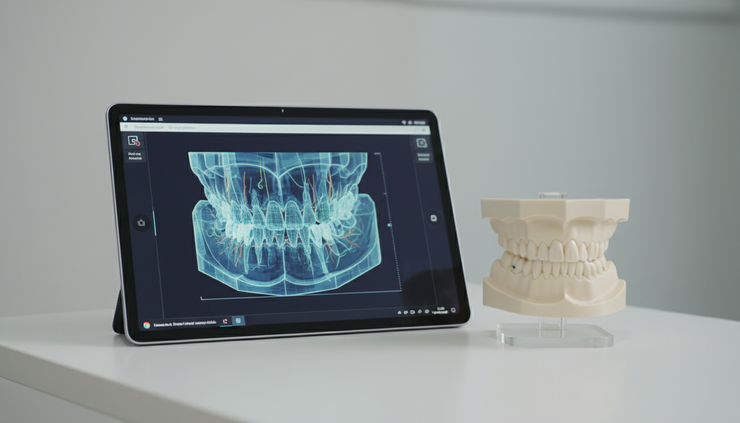
This is one reason digital planning has become so valuable. Surgeons can evaluate how jaw movement changes the chin position before deciding whether separate chin surgery is needed.
How diagnosis guides the right treatment
A proper plan starts with a full evaluation, not a quick glance at the profile. The same outward concern, such as a recessed chin, can come from different anatomical causes.
A complete evaluation may include several parts.
Facial examination
The surgeon evaluates the face from the front, side, and three-quarter views. This includes facial proportions, lip posture, chin projection, symmetry, lower facial height, jawline contour, and soft tissue thickness.
Bite analysis
The dental bite shows whether the jaw relationship is functional and stable. The clinician looks at overjet, overbite, midlines, dental compensation, tooth angulation, crowding, spacing, and how the teeth contact.
CBCT imaging
Cone beam computed tomography, or CBCT, provides three-dimensional information about the jaws, airway space, teeth, roots, and facial skeleton. It can help distinguish a chin deficiency from mandibular retrusion.
3D planning
Three-dimensional planning allows the surgical team to simulate movements of the upper jaw, lower jaw, and chin. It can show how a sliding genioplasty, BSSO, mandibular advancement, or double jaw surgery may change both structure and appearance.
This process helps prevent a common mistake: treating the visible concern while missing its source.
Treat the anatomical source, not just the appearance
The discussion about genioplasty vs jaw surgery should not be framed as one procedure competing with the other. They answer different questions.
Genioplasty asks: Does the chin itself need to move?
Jaw surgery asks: Does the jaw need to move to correct the bite, profile, or skeletal relationship?
If the chin is deficient and the bite is healthy, sliding genioplasty may be the most direct option. If the lower jaw is retruded and the bite is skeletal, mandibular advancement with BSSO may address the deeper issue. If both jaws contribute to the imbalance, double jaw surgery may be part of the plan. If the jaw and chin both need adjustment, combining orthognathic surgery with genioplasty may provide the best balance between function and appearance.
The right treatment should match the anatomy. A careful facial examination, bite analysis, CBCT imaging, and 3D plan help define whether the concern is a recessed chin, a recessed jaw, or both.
The best result is not simply a stronger profile. It is a treatment plan that respects the bite, supports facial balance, and corrects the real source of the concern.


Comments